Share
Save
Ready
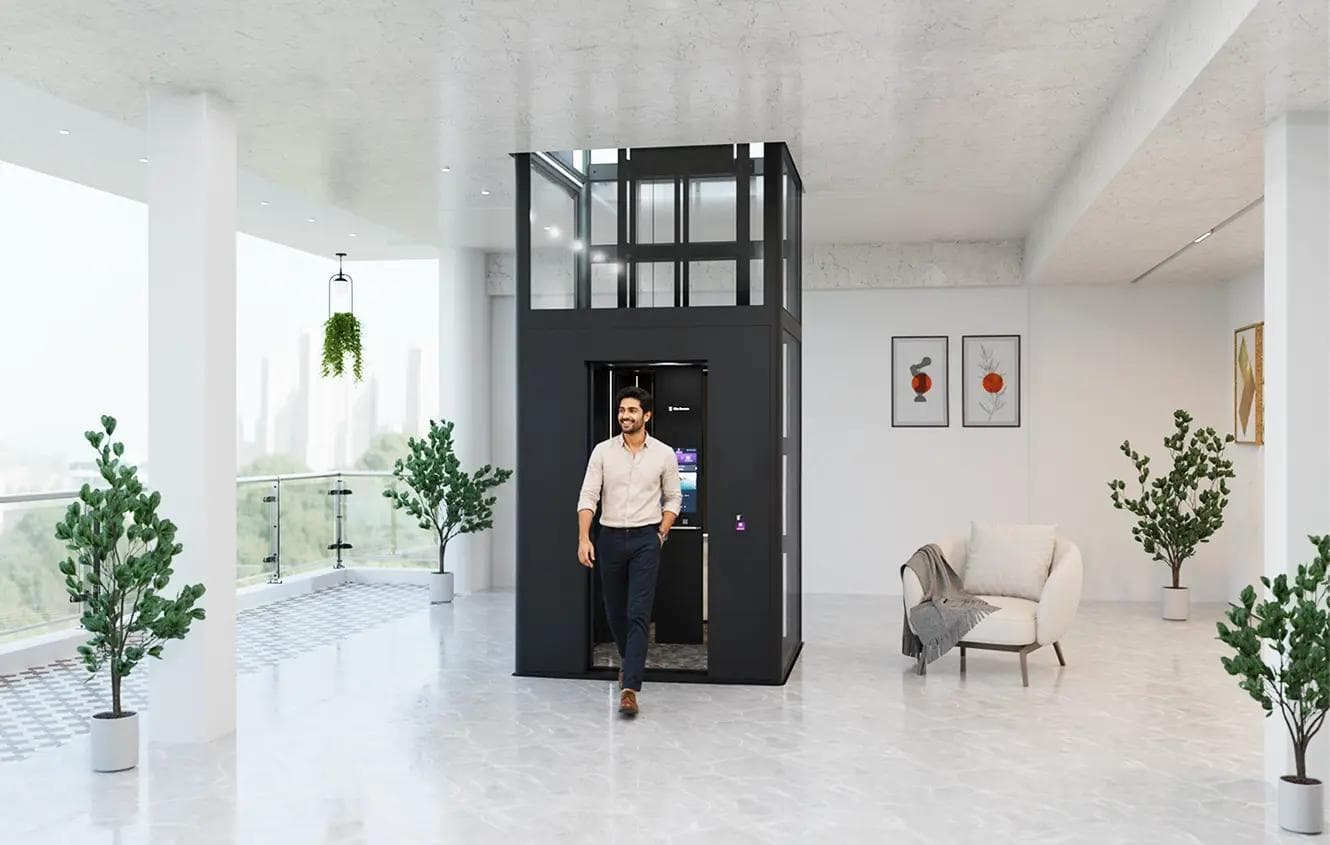
A home elevator can fit in most existing Indian houses with a pit depth as shallow as 59mm, no separate machine room, and a cabin footprint of 1200×1200mm. Elite Elevators' retrofit models install in 2–3 weeks with minimal civil work and no major structural changes required.
You've lived in your home for years. The structure is done. The interiors are finished. And now—whether it's ageing parents, knee surgery, or simply the daily exhaustion of climbing three floors—you've realised you need a home elevator. But the house is already built. Walls are in place. The staircase is fixed. And the idea of tearing everything apart for a lift feels impossible.
Many Indian homeowners assume that installing a home lift in an existing house is almost impossible. They believe it requires a deep pit, a separate machine room, major structural changes, and months of construction work. Because of these assumptions, many give up on the idea before even exploring the available options. In reality, modern residential retrofit lifts are specifically designed for existing homes and can often be installed with minimal space and very little structural modification.
The good news: home elevators for existing house installation is not only possible – it's what Elite Elevators does every single day across India. This guide answers every question you have, with real specifications, real timelines, and real options for your home.
The most important thing to understand about retrofit home elevator Chennai installations is that modern residential lifts are engineered specifically for existing spaces – not just new constructions.
Three factors determine whether your home can accommodate a lift:
Pit depth — the shallow recess at the base of the elevator shaft. Elite Elevators' X300 series requires just 59mm. The X200 and E200 require 100–120mm. In most Indian homes, this recess can be created without any impact on plumbing, foundations, or structural elements. It is a minor civil task — not a construction project.
Headroom — the vertical clearance at the top of the elevator's travel. The X200 requires a headroom of 2,300mm — a standard ceiling height in most Indian homes. The X300 and E-series requirements are similarly modest, making them compatible with existing construction without raising roofs or modifying structures.
Footprint — the floor area the elevator cabin and shaft occupy. Elite Elevators' standard cabin is 1,200×1,200mm — roughly the footprint of a small wardrobe. In most G+1 to G+3 Indian homes, a suitable corner, corridor end, or space adjacent to the staircase can accommodate this footprint without sacrificing a meaningful living area.
No machine room is required for any Elite Elevators model. This alone eliminates the single biggest civil requirement that previously made retrofit installation complicated.
The added elevator to an existing home decision is driven by several distinct situations — each with its own urgency and timeline.
Families with elderly parents represent the most common retrofit scenario. A G+2 or G+3 home that worked perfectly for an active family becomes genuinely difficult when parents reach their 70s with joint pain, reduced balance, or post-surgery mobility limitations. The decision is rarely planned — it is triggered by a fall, a near-miss, or a frank conversation with a doctor. At that point, speed of installation matters as much as quality.
Post-surgery and disability scenarios where a family member's mobility changes suddenly. A knee replacement, a hip fracture, or a neurological condition can transform a well-designed home into an obstacle course overnight. In these cases, the retrofit elevator is not a lifestyle upgrade — it is a medical necessity.
Homeowners during renovation who are already disrupting the house for other improvements. This is the most cost-effective retrofit moment — when walls are open, floors are up, and a civil team is already on site. Including elevator preparation at this stage adds minimal incremental cost.
The misconception that elevators without machine room installation require massive civil work is a legacy of commercial elevator technology — not residential.
Commercial elevators require deep pits (600mm–1000mm), dedicated overhead machine rooms, and heavy structural reinforcement because they carry heavy loads at high speeds across many floors. None of these requirements apply to a residential lift serving 3–4 floors in a family home.
Elite Elevators' residential range is designed from the ground up for Indian homes – with pit depths starting at 59mm, no machine room, single-phase power supply, and installation timelines of 2–3 weeks. The civil work required is genuinely minimal — in most cases limited to the shallow pit, a standard electrical connection, and the creation of landing door openings on each floor.
Another common misconception is that the process is disruptive — that the family will need to vacate, that dust and noise will be constant, and that the installation will drag for months. In reality, Elite Elevators' modular installation approach is designed to minimise household disruption. Most installations are completed floor by floor, with minimal impact on daily routines.
The right retrofit home elevator Chennai model depends on your home's configuration, your family's needs, and your budget.
X200 (₹14.50L for G+1) — the most practical retrofit choice for budget-conscious families. Hydraulic chain drive, 400kg capacity, 100mm pit depth, no machine room, manual swing door option. Suitable for G+1 to G+3 homes. Cabin customisation options available.
X200 Plus (₹16.75L for G+1) — adds smart features including a 21" Live Board display, mobile app control, Live SOS emergency alerts, and PIN-based floor access. Ideal for families who want to monitor and manage the lift remotely.
X300 MK II (₹18.70L for G+1) — gearless belt drive, 59mm pit depth (the smallest available), EGSS zero-jerk technology, and pre-door opening system. The most space-efficient retrofit option. Covers up to G+5.
X300 MK II Plus (₹20.95L for G+1) — India's only AI-powered home elevator. Adds Elite AI, biometric floor selection, VisionLog cabin camera, and four customisable ride modes. Ideal for smart homes and technology-forward families.
E200 Standard (₹26.80L for G+1) — European hydraulic engineering, EN 81-41 certified, 194 integrated safety parameters, 120mm pit. For families seeking the highest safety certification in a retrofit hydraulic lift.
E300 (₹32.50L for G+1) — premium Italian-engineered gearless cogbelt home elevator with ultra-silent operation, up to 400kg capacity, 140mm pit depth, and support for up to 6 stops. Ideal for luxury villas and homeowners seeking premium comfort, safety, and long-term performance in an existing house.
Understanding the add-on elevator to an existing home process removes the anxiety around it. Here is exactly what happens with Elite Elevators:
Step 1 — Free Site Assessment: Elite Elevators' engineers visit your home, assess the layout, identify the optimal elevator position, and confirm the pit depth and headroom requirements for your chosen model.
Step 2 — Design and Specification: Cabin finishes, colours, ceiling design, and smart features are selected. A detailed site drawing is produced and shared with your architect or contractor if civil preparation is required.
Step 3 — Civil Preparation: The shallow pit is created, floor openings for landing doors are made, and the electrical connection is prepared. This phase typically takes 3–5 days and is managed by your local contractor with Elite Elevators' guidance.
Step 4 — Installation: Elite Elevators' trained engineers install the lift structure, cabin, drive system, doors, and control systems. Most installations complete in 2–3 weeks from the start of installation.
Step 5 — Testing and Handover: The completed lift undergoes comprehensive safety testing, including load testing, emergency rescue testing, and smart feature verification. The homeowner is walked through operation and the after-sales support structure.
The only way to know for certain whether your home can accommodate a lift is to have an expert assess it. Elite Elevators offers a free home visit — their engineers come to your property, evaluate the space, and give you a clear, no-obligation recommendation.
Yes. Elite Elevators' residential lifts are specifically designed for retrofit installation in existing Indian homes. They require a pit depth of only 59–120mm, no separate machine room, and installation in 2–3 weeks with minimal civil disruption.
The minimum cabin footprint is 1,200×1,200mm — approximately the size of a small wardrobe. Combined with a 59–120mm pit depth and standard ceiling heights, most Indian G+1 to G+3 homes can accommodate an Elite Elevators lift without major structural changes.
Retrofit home elevator costs from Elite Elevators start at ₹14.50 lakhs for a G+1 home (X200 model), all inclusive of delivery, installation, and cabin customisation. No hidden charges are added at the invoice stage.
Not necessarily. In most Indian homes, the elevator can be positioned in an unused corner, alongside the staircase, or as an external X-shaft addition that avoids internal structural work. Elite Elevators' site assessment identifies the least invasive position for your specific home.
Most Elite Elevators installations are complete within 2–3 weeks from the start of installation. The process is modular and managed to minimise disruption to daily household routines.
Riyash is a Home Mobility Consultant and Technical Writer at Elite Elevators, India's leading provider of premium residential elevator solutions. With hands-on experience in elevator installation planning, safety compliance, and residential infrastructure across Indian cities, Riyash helps homeowners navigate the technical and practical aspects of choosing the right home lift. His articles focus on hydraulic elevator technology, accessibility design, installation best practices, and smart vertical mobility trends shaping modern Indian homes. Riyash is committed to helping families make confident, well-informed elevator decisions for their homes.



