Share
Save
Click to listen
When a family member uses a wheelchair, every floor of a multi-storey Chennai home can quietly become off-limits. The bedroom upstairs, the terrace, the guest room — all suddenly require someone else's help to reach, every single time.
Over time, this isn't just inconvenient — it chips away at independence and dignity. Family members feel like a burden for needing help with something as simple as moving between floors of their own home. And many standard home elevators, designed primarily for compact footprints, aren't actually built with wheelchair manoeuvrability in mind — narrow doorways, tight turning space, and high thresholds can make them impractical for genuine accessibility needs.
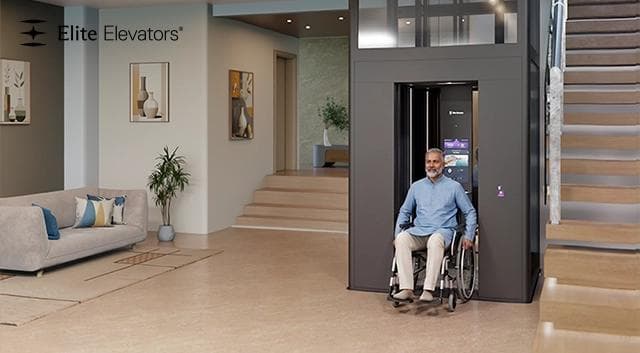
The right wheelchair-accessible home elevator changes this completely. This guide explains what genuinely makes a Chennai home elevator wheelchair-friendly, what to look for, and which models deliver real, dignified accessibility — not just a slightly bigger box.
A wheelchair-accessible elevator is not simply a larger cabin — it is engineered around the specific physical needs of a wheelchair user. Genuine accessibility includes:
Adequate Cabin Dimensions:
Standard manual wheelchairs require a minimum of approximately 900×1400 mm to manoeuvre comfortably. Elite Elevators' XL cabin option, available across the X300 series, measures 1500×1500 mm — providing genuine turning space, not just a tight fit.
Barrier-Free, Step-Free Entry:
Door thresholds must be flush with zero height difference between the landing floor and the cabin floor. Pitless models with precise auto-levelling — like the X300 series — ensure the cabin stops perfectly flush at every floor, every time.
Wide Door Openings:
Doors must open wide enough for a wheelchair to pass through without manoeuvring at an angle — a critical detail many compact home elevators overlook in favour of a smaller footprint.
Accessible Control Panels:
Buttons and touch panels positioned at a height reachable from a seated position — not designed exclusively for a standing adult's eye level and reach.
For a wheelchair user, ride quality isn't a comfort feature — it's a safety requirement. The following features make the genuine difference:
Jerk-Free Start and Stop (EGSS Technology):
A sudden jolt during start or stop can be genuinely destabilising for a wheelchair user without the ability to brace. Elite Elevators' EGSS technology, standard across the X300 series, delivers gentle, gradual acceleration and deceleration on every trip.
Precision Auto-Levelling (MDR):
Magnetic Driven Controls ensure the cabin stops perfectly flush with the floor — eliminating the small but genuinely hazardous gap or step that can catch wheelchair wheels or castors.
Automatic Rescue Device (ARD):
In a power cut, a wheelchair user should never be left stranded mid-floor without assistance. The ARD automatically brings the cabin to the nearest floor and opens the doors — critical for independent use.
Door Obstruction Sensors:
Doors must reverse immediately if a wheelchair footrest, armrest, or wheel triggers the sensor — a feature standard across all Elite Elevators models.
Many Chennai families search for a wheelchair-accessible elevator while actually planning for an elderly parent who may or may not eventually need a wheelchair. It's worth understanding the distinction:
Seniors generally benefit from gentle ride quality, simple controls, and a seated stairlift option (the E50) if the home has only one or two floors that need bridging. Full wheelchair users — whether due to permanent mobility limitations, post-surgical recovery, or progressive conditions — need a true wide-cabin elevator with barrier-free access across every floor of the home, not just a stair-specific solution.
For families uncertain about future needs, specifying the XL cabin option now — even before it's strictly necessary — avoids a costly retrofit later. This is a planning conversation worth having directly with your elevator engineer during the home assessment.
Installing a wheelchair-accessible elevator in an existing Chennai home requires careful planning beyond a standard installation:
Site Assessment for Turning Radius:
Engineers assess not just the lift shaft but the approach space on each floor — a wheelchair needs room to manoeuvre into and out of the cabin comfortably, not just inside it.
Threshold and Flooring Continuity:
Landing floor finishes are matched in height to the cabin floor to eliminate any lip or step — a detail that requires precise installation planning, particularly in retrofit scenarios.
Caregiver Space Consideration:
Where a caregiver regularly accompanies the wheelchair user, the XL cabin configuration provides enough space for both to travel together comfortably — an important consideration many families overlook when initially sizing the elevator.
This isn't a niche requirement — it serves a broader range of Chennai families than the name suggests:
Family members with permanent mobility disabilities requiring full wheelchair use across the home
Elderly parents in multi-generational Chennai households who may transition to wheelchair use over time
Individuals recovering from surgery or injury who need temporary but genuine wheelchair access
Families planning ahead — building or renovating a home with long-term accessibility in mind, regardless of current need
Give every family member true independence in your Chennai home.
Book a free, no-obligation home assessment with Elite Elevators at eliteelevators.com. Our team will recommend the right wheelchair-accessible configuration for your home and family.
A minimum of 900×1400 mm allows basic wheelchair manoeuvrability. For genuinely comfortable access, including space for a caregiver, the XL cabin option (1500×1500 mm) available on Elite Elevators' X300 series is strongly recommended.
Yes. Pitless models like the X300 series require only 59–100 mm of floor preparation and no machine room, making retrofit installation in existing homes practical — though careful planning around turning radius and threshold continuity is essential.
A stairlift (like the E50) carries a seated passenger along the staircase and is suitable for seniors who can transfer from wheelchair to stairlift seat. A full wheelchair elevator allows the wheelchair user to remain seated in their own chair throughout, making it essential for permanent or full-time wheelchair users.
The XL cabin upgrade adds a moderate premium over the standard cabin size, but the underlying technology and safety systems are otherwise identical. Book a free home assessment with Elite Elevators in Chennai for an accurate quote based on your specific home and needs.
Look for EN 81-41 European certification, which covers safety standards specific to low-speed residential lifts including those designed for accessibility use. All Elite Elevators models meet this standard or higher.
Riyash is a Home Mobility Consultant and Technical Writer at Elite Elevators, India's leading provider of premium residential elevator solutions. With hands-on experience in elevator installation planning, safety compliance, and residential infrastructure across Indian cities, Riyash helps homeowners navigate the technical and practical aspects of choosing the right home lift. His articles focus on hydraulic elevator technology, accessibility design, installation best practices, and smart vertical mobility trends shaping modern Indian homes. Riyash is committed to helping families make confident, well-informed elevator decisions for their homes.



